 EXREY
Oppenheimer: The True Story Behind Christopher Nolan's Film
Yes. Oppenheimer (2023, written and directed by Christopher Nolan) tells the true story of J. Robert Oppenheimer, the physicist who led the Los Alamos laboratory during the Manhattan Project and oversaw the first atomic bomb test in July 1945. It is based on the Pulitzer Prize-winning biography American Prometheus (2005) by Kai Bird and Martin J. Sherwin, and follows his life up to the 1954 security hearing that ended his career in government.
Christopher Nolan's Oppenheimer won seven Academy Awards in 2024, including Best Picture, Best Director and Best Actor for Cillian Murphy. It is also one of the most faithful big-budget biopics of recent years: most of what happens on screen happened, and many lines come close to what people actually said or wrote.
Who was J. Robert Oppenheimer?
Oppenheimer was born in New York in 1904 into a wealthy family. He studied at Harvard, then at Cambridge and in Göttingen, where he earned his doctorate in the new field of quantum mechanics. Back in the United States he built one of the strongest schools of theoretical physics in the country at the University of California, Berkeley.
In 1942 General Leslie Groves (played by Matt Damon) chose him to lead the secret laboratory at Los Alamos, New Mexico, where the first atomic bombs were designed. It was an unusual choice: Oppenheimer was a theorist with no experience running anything of that size, and he had close ties to people in the Communist Party.
What really happened at Los Alamos and Trinity
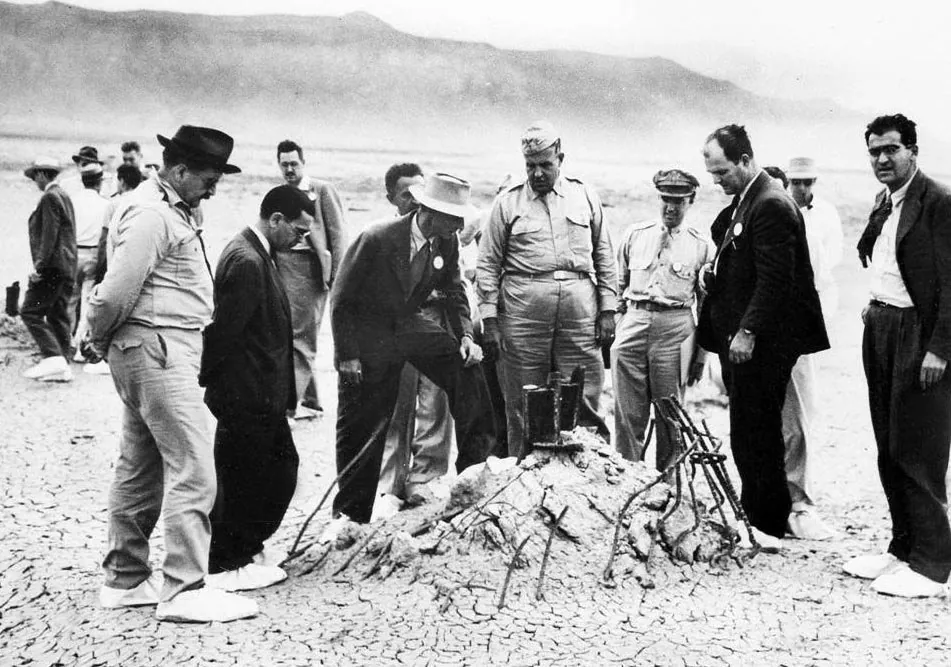
The film's long middle section follows the real arc of the Manhattan Project. Los Alamos grew from a ranch school to a town of thousands of scientists and their families. On 16 July 1945, in the desert of southern New Mexico, the team detonated the first nuclear device - the test Oppenheimer named Trinity. Weeks later, bombs were dropped on Hiroshima and Nagasaki.
Oppenheimer later said that during the test he thought of a line from the Bhagavad Gita: "Now I am become Death, the destroyer of worlds." The film uses the line twice; in reality he spoke about it publicly in a 1965 television interview.
The 1954 hearing
The third thread of the film - the closed-door hearing - is also real. After the war Oppenheimer became a powerful adviser, and he opposed the crash programme to build the hydrogen bomb. In 1954 the Atomic Energy Commission, chaired by Lewis Strauss (Robert Downey Jr.), held a hearing on his security clearance. His past left-wing associations, his affair with Jean Tatlock and his opposition to the H-bomb were all used against him, and his clearance was not restored.
The black-and-white scenes of Strauss's 1959 Senate confirmation hearing are true too: the Senate voted against making Strauss Secretary of Commerce, and the scientist David Hill really testified against him.
In December 2022 the US Department of Energy formally vacated the 1954 decision, saying it was the result of a flawed process. Oppenheimer did not live to see it; he died of throat cancer in 1967.
What the film changed
- Einstein's conversation by the pond is invented, although Oppenheimer and Einstein did know each other at the Institute for Advanced Study in Princeton.
- The poisoned apple at Cambridge comes from biographers' accounts and is not fully confirmed; the film presents it as fact.
- Time is compressed. Years of committee work and several witnesses are folded into a few characters and scenes.
Why the story still matters
The film's real subject is not the bomb but the man who built it and could not control what came next. Oppenheimer spent the rest of his life arguing for international control of nuclear weapons - and was pushed out of the decisions for exactly that reason. It is a story about how fast a person can go from national hero to suspect, and how long it can take for that to be put right.
Questions people ask
Is Oppenheimer based on a true story?
Yes. It follows the real life of J. Robert Oppenheimer (1904-1967) and is adapted from the biography American Prometheus by Kai Bird and Martin J. Sherwin.
Did Oppenheimer really lose his security clearance?
Yes. After a hearing in 1954 the Atomic Energy Commission refused to restore his clearance. In December 2022 the US Department of Energy vacated that decision, calling the process flawed.
Was Lewis Strauss really behind Oppenheimer's downfall?
Historians agree Strauss played a central role in the 1954 hearing. In 1959 the Senate rejected Strauss's nomination as Secretary of Commerce, in part over his treatment of Oppenheimer, as the film shows.
Did the Trinity test scene use CGI?
Nolan said the explosion was created with practical effects rather than computer graphics.