 EXREY
127 Hours: The True Story of Aron Ralston
Yes. 127 Hours (2010, directed by Danny Boyle, with James Franco) is based on Aron Ralston's memoir Between a Rock and a Hard Place. In April 2003 a falling boulder pinned his right hand in Bluejohn Canyon, Utah. After five days alone he broke the bones of his forearm, cut through it, rappelled down a 65-foot drop and walked out until a family on a hike found him.
Some true stories are hard to film because too little happens. In 127 Hours almost nothing moves for most of the running time - one man, one rock, one arm - and that is exactly why it works. It is also one of the most faithful true-story films ever made.
What happened in Bluejohn Canyon
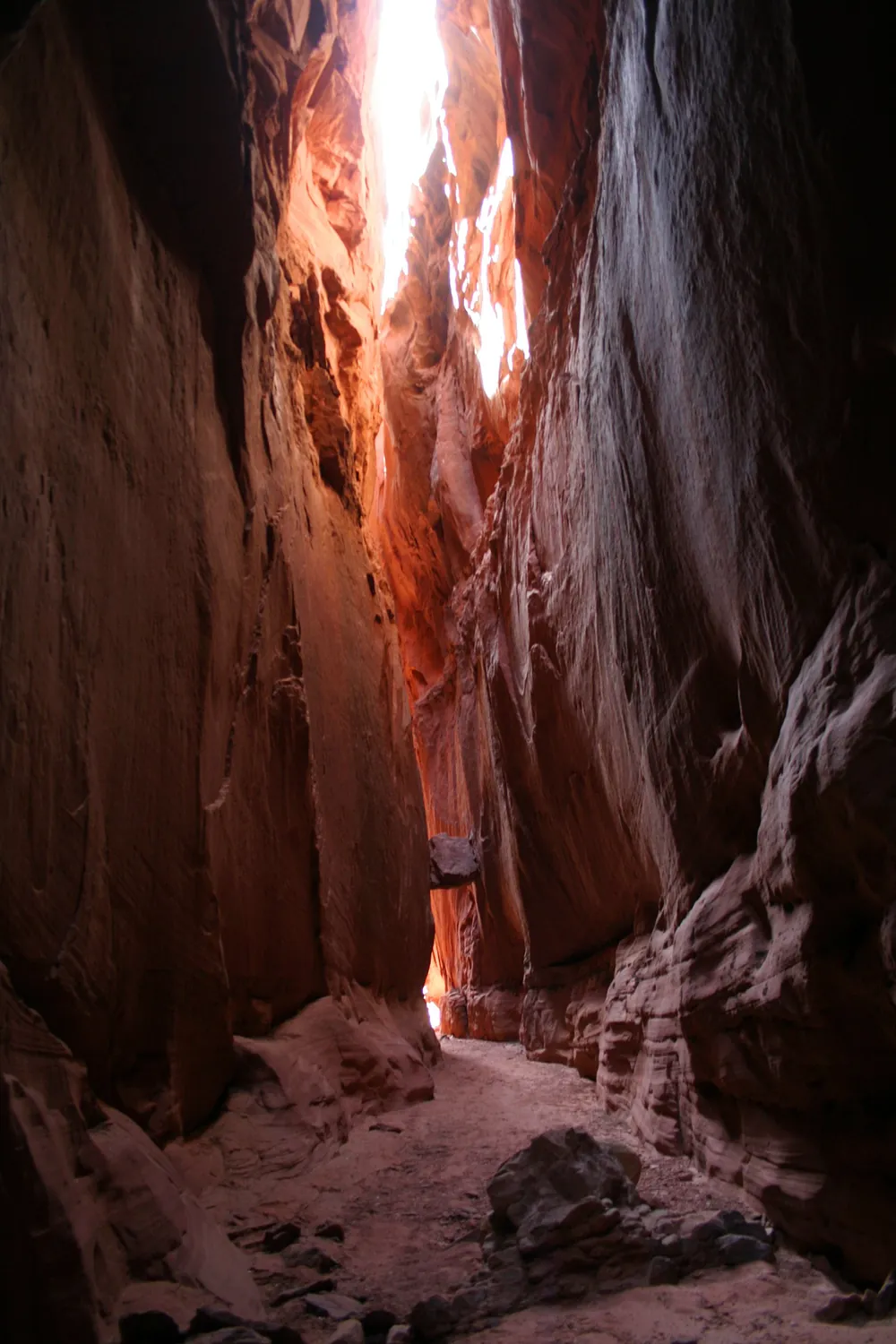
On 26 April 2003 Aron Ralston, an experienced climber, went alone into Bluejohn Canyon, a narrow slot canyon in Wayne County, Utah, near Canyonlands National Park. He told no one where he was going.
While he was climbing down through a narrow section, a boulder shifted and fell, pinning his right hand against the canyon wall. He could not move it. He had a little water, some food, climbing gear and a cheap multi-tool with a dull two-inch blade, and nobody knew where to look for him.
He spent the next five days there. He rationed his water, tried to lift the boulder and to chip it away, recorded goodbye messages to his family on his video camera and carved his name, his date of birth and the date he expected to die into the sandstone.
The decision
By the fifth day he had run out of water and was certain he would die if he stayed. The blade of his multi-tool was too blunt to cut through bone, so he worked out another way: he used his trapped arm as a lever and broke both bones of his forearm - the radius and the ulna. Then he cut through the rest of his arm with the multi-tool. It took about an hour.
Getting out
Free, but badly injured, he still had to get out of the canyon. He rappelled down a 65-foot drop one-handed and began walking towards his car, miles away in the desert heat. On the way he met a family on holiday from the Netherlands, who gave him food and water and alerted the authorities. By then rescuers had narrowed their search to the area, and a helicopter picked him up about four hours after he had freed himself.
How the film tells it
Danny Boyle wrote the treatment and Simon Beaufoy the screenplay, and the film was shot in Utah in 2010. Boyle's problem was obvious: one man stuck in one place for most of the running time. His answer was to stay inside Ralston's head. The video diary Ralston really kept becomes the film's way of letting him speak, and the long days are filled with what he remembered and imagined - his family, a former girlfriend, a party he had been invited to and would never reach.
The amputation scene became famous on its own. At early festival screenings there were reports of viewers fainting or being taken ill, although not all of those reports were confirmed. Boyle kept the scene short, but he did not cut away, because the whole film builds towards that decision.
The film cost about $18 million and took about $60.7 million worldwide. Ralston, his wife and his son appear briefly at the end.
What the film changed
Very little. Ralston has said the film is about as close to a documentary as you can get and still be a drama, and the changes are small:
- Early on, Ralston meets two hikers. In the film he shows them a hidden pool; in reality he showed them some basic climbing moves.
- A vision of his future son shows him with two arms, although in his own account he saw himself with one.
The film, directed by Danny Boyle with James Franco as Ralston, was nominated for six Oscars, including Best Picture and Best Actor.
After the canyon
Ralston wrote about the accident in Between a Rock and a Hard Place, published in September 2004, and went back to the mountains. He climbed Aconcagua, the highest peak in the Americas, and in 2005 he also became the first person to climb all of Colorado's 59 named "fourteeners" - peaks over 14,000 feet - alone and in winter. He has worked as a motivational speaker.
Why it matters
The story is not only about courage at the end but about the start: he went alone and had told no one where he was going. 127 Hours is a story about survival, and a reminder that the simplest precaution - leaving word of where you are going - is often the one that matters most.
Questions people ask
Is 127 Hours a true story?
Yes. It follows Aron Ralston's accident in Bluejohn Canyon, Utah, on 26 April 2003, as he told it in his 2004 book Between a Rock and a Hard Place.
How long was Aron Ralston trapped?
Five days - about 127 hours, which gave the film its title.
How did Aron Ralston get his arm free?
He broke the two bones of his right forearm by using his trapped arm as a lever, then cut through it with a dull multi-tool. It took about an hour.
How accurate is 127 Hours?
Very. Ralston has said the film is about as close to a documentary as a drama can get. Only small details were changed, such as what he showed two hikers he met that morning.