 EXREY
The Big Short: The True Story of the Men Who Bet Against the 2008 Crash
Yes. The Big Short (2015, directed by Adam McKay) is based on Michael Lewis's 2010 book about the few investors who bet that the US housing market would collapse. Michael Burry is shown under his own name; Steve Eisman, Greg Lippmann, Ben Hockett and the founders of Cornwall Capital appear under changed names.
The Big Short plays like a heist film in which the thieves are the banks and the heroes are a few people who simply read the paperwork. It is also, almost scene for scene, a true story.
The book behind it
The film is based on Michael Lewis's book The Big Short: Inside the Doomsday Machine, published in 2010, two years after the crash. Lewis followed a small group of outsiders who noticed, years before everyone else, that the American housing market was built on loans that could not be repaid. Director Adam McKay turned it into a film in 2015, and he and Charles Randolph won the Oscar for Best Adapted Screenplay.
Michael Burry: the one who went first
The only main character who keeps his real name is Michael Burry, played by Christian Bale. Burry trained as a doctor - he earned an MD from Vanderbilt in 1997 and began residencies at Stanford - but he had been writing about stocks on the side, and in late 2000 he started his own fund, Scion Capital.
In 2005 he concluded that the subprime mortgage market would fail. Instead of simply avoiding it, he persuaded big banks, Goldman Sachs among them, to sell him credit default swaps - in effect, insurance that would pay out if those mortgage bonds collapsed. The swaps cost him premiums every month while the housing market kept rising, and his investors grew furious. The film's angry investor, Lawrence Fields, is a composite of several of them.
The film gets the frustration right: for a long time the bet looked wrong. When the market finally broke in 2007, Burry was proven right. His fund made its investors more than $700 million and him about $100 million personally. He closed Scion in 2008.
How the bet worked, in one paragraph
A credit default swap is a promise: one side pays a fee every month, and the other side pays out a large sum if a particular bond fails. Burry and the others were paying those fees on bonds made of risky home loans. If homeowners kept paying, the fees were simply lost money. If enough homeowners defaulted, the bonds collapsed and the swaps paid many times what they had cost. The whole drama of the film is the wait in between, when the fees kept going out and the market refused to fall.
The names that were changed
Most of the other characters are real people under new names:
- Mark Baum (Steve Carell) is Steve Eisman of FrontPoint Partners, who bet against the same mortgage bonds and called the subprime industry morally bankrupt.
- Jared Vennett (Ryan Gosling), the Deutsche Bank salesman who sells the bet on to other investors, is based on Greg Lippmann.
- Ben Rickert (Brad Pitt), the retired banker, is based on Ben Hockett.
- Charlie Geller and Jamie Shipley, the two young investors working from a garage, are Charlie Ledley and Jamie Mai of Cornwall Capital.
The film never pretends to be a documentary; it breaks the fourth wall, and a few scenes are invented for clarity. But the trades, the people and the warnings they gave are real.
What the film explains - and what really happened
The famous celebrity explainers (a bubble bath, a casino table) are there because the crisis really was built on financial products almost nobody understood: mortgages bundled into bonds, those bonds bundled again, and ratings agencies giving much of it top ratings. When homeowners stopped paying, the whole structure failed at once.
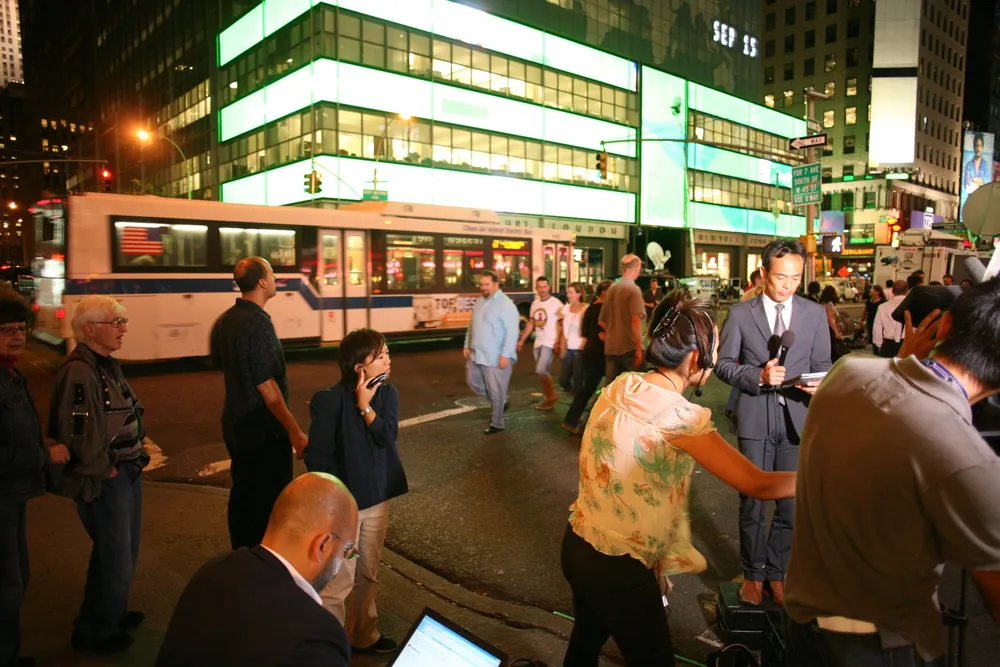
The consequences were not a movie twist. In September 2008 Lehman Brothers filed for bankruptcy - the photo above was taken outside its headquarters that day - and the crisis spread through the world economy. Millions of people in the United States lost their homes or their jobs.
That is why the film ends uneasily. The men who saw it coming made money, but the story is not a celebration: their bet paid off because the system it bet against fell on millions of ordinary people.
Where are they now?
Burry reopened his firm in 2013 as Scion Asset Management and kept making public, often gloomy, calls about markets; in November 2025 he deregistered that fund. Steve Eisman continued working as an investor and commentator. Their warnings about how easily the financial system can hide risk remain the real point of the story.
Why it matters
The Big Short is a rare film that teaches as it entertains. Its true story is not about genius alone; it is about people who did the dull work of reading what others assumed was fine, and kept their nerve while everyone told them they were wrong.
Questions people ask
Is The Big Short based on a true story?
Yes, on Michael Lewis's non-fiction book The Big Short: Inside the Doomsday Machine (2010) about the 2007-2008 subprime mortgage crisis.
Who is Mark Baum in real life?
Steve Carell's Mark Baum is based on Steve Eisman. Ryan Gosling's Jared Vennett is based on Greg Lippmann, and Brad Pitt's Ben Rickert on Ben Hockett.
How much did Michael Burry make?
According to his Wikipedia biography, his fund made its investors more than $700 million and him about $100 million personally.
Is Michael Burry a doctor?
He trained as one - he earned an MD from Vanderbilt in 1997 and started residencies at Stanford - before turning to investing full time.