 EXREY
Sully: The True Story of the Miracle on the Hudson
Yes. Sully (2016, directed by Clint Eastwood, with Tom Hanks) tells the true story of US Airways Flight 1549. On 15 January 2009 a flock of Canada geese knocked out both engines just after take-off from LaGuardia, and Captain Chesley Sullenberger and First Officer Jeffrey Skiles landed the Airbus A320 on the Hudson River. All 155 people aboard survived.
Most disaster films have to invent their drama. Sully had the opposite problem: the real event lasted less than four minutes and ended with everybody alive. What Clint Eastwood's film adds, and what it changes, says a lot about how true stories get told.
What happened on 15 January 2009
US Airways Flight 1549 took off from LaGuardia Airport in New York in the afternoon, bound for Charlotte and then Seattle. The aircraft was an Airbus A320. In the cockpit were Captain Chesley "Sully" Sullenberger, 57, and First Officer Jeffrey Skiles, 49.
At about 2,800 feet the plane flew into a flock of Canada geese. Birds went into both engines, and both lost almost all of their thrust. A modern airliner had become, in effect, a very heavy glider over one of the most crowded cities in the world.
Sullenberger took the controls and started the auxiliary power unit - a step the checklist had not reached yet, and which the NTSB later called critical, because it kept electrical power on and the fly-by-wire controls in their normal mode - while Skiles worked through the emergency checklist. That checklist had been written for an engine failure at high altitude, above 20,000 feet, where a crew has minutes to work through it; at under 3,000 feet they had nothing like that time. Air traffic control offered a return to LaGuardia and then a landing at Teterboro in New Jersey. Sullenberger judged that he could reach neither. The cockpit voice recorder caught his answer to the controller: "We're gonna be in the Hudson."
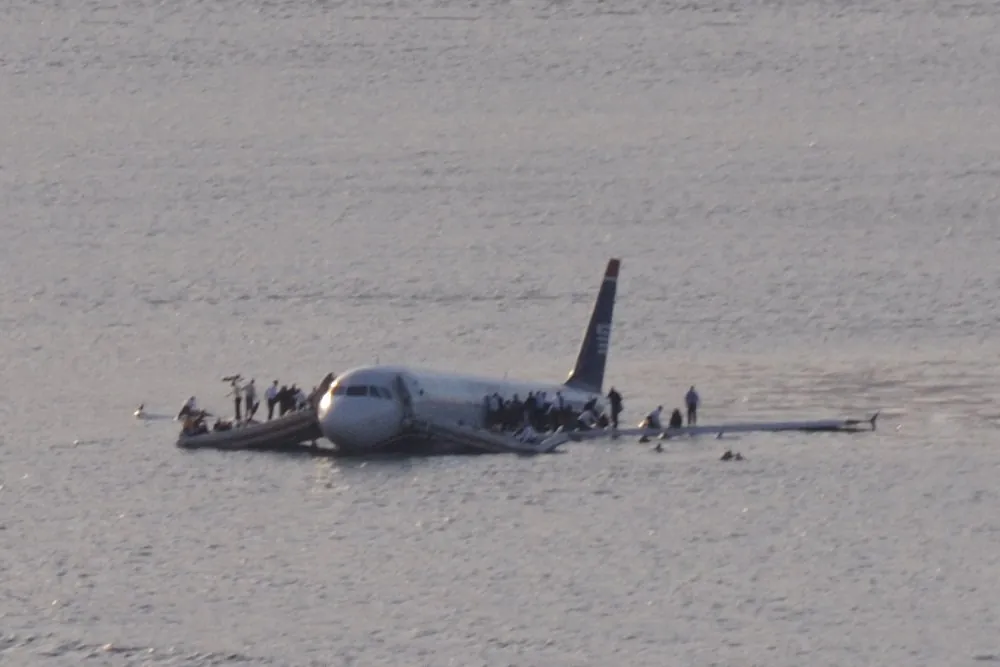
Less than four minutes after the bird strike he put the plane down on the Hudson River, next to Midtown Manhattan. The aircraft stayed afloat. It came to rest near the ferry terminal at Weehawken, New Jersey. Passengers climbed out onto the wings and into inflatable slides, and New York Waterway ferries that were already working the river turned towards them; the first arrived within about four minutes, and seven of the company's boats took part in the rescue. All 155 people aboard - 150 passengers and 5 crew - survived. About 100 were injured, five seriously.
The birds
The NTSB took bird remains from both engines and the wings and had them analysed. The Smithsonian Institution's feather identification laboratory confirmed Canada geese, and a further analysis of the feathers showed they were migratory birds rather than geese living around New York all year. A Canada goose weighs around 7 to 9 pounds, and each engine had taken at least one bird of about 8 pounds into its core - well beyond what the engines' bird-ingestion certification tests require. The report's probable cause is simply the ingestion of large birds into each engine, which caused an almost total loss of thrust in both.
The investigation - what the film changed
The film's main conflict is the investigation by the National Transportation Safety Board (NTSB). On screen, investigators appear to doubt Sullenberger and to suggest he could have made it back to an airport.
In reality the NTSB did examine that question, as it does after every accident. Its report describes simulator runs in which pilots, knowing exactly what would happen, turned back the moment the engines failed. Eight of fifteen such runs reached a runway. But the Board pointed out that an immediate turn does not reflect real life, where a crew first has to understand what has happened. The one run that included a 35-second delay for that did not make it.
The NTSB's conclusion was clear: the captain's decision to ditch on the Hudson rather than try for an airport gave the best chance of survival. The crew's decisions and teamwork were credited in the report.
The film's version of the inquiry drew criticism. A writer in The New York Times said it departed from the official record in tone and substance, and the NTSB's lead investigator, Robert Benzon, said the investigators had not been out to embarrass anyone and called the film's depiction of them inaccurate. Dramatising a public hearing into a near-trial is the film's biggest liberty.
What the film got right
Almost everything about the flight itself. The timeline, the birds, the decision, the calm voices in the cockpit and the speed of the rescue are close to the record. The film is based on Highest Duty, the 2009 book by Sullenberger with Jeffrey Skiles, and Tom Hanks plays Sullenberger with the same understatement the real captain showed in interviews.
Why it matters
The "Miracle on the Hudson" was not luck alone. It came from two experienced pilots who made the right decision in seconds, a cabin crew who got everyone out, and boat crews who arrived fast. The investigation that followed, far from attacking the pilots, confirmed that their choice had been the safest one - and its findings about bird strikes and ditching procedures were meant to make the next such flight safer still.
Questions people ask
Is Sully based on a true story?
Yes, on the ditching of US Airways Flight 1549 on 15 January 2009 and on Sullenberger's 2009 book Highest Duty, written with Jeffrey Skiles.
Did everyone survive the Hudson landing?
Yes. All 155 people aboard - 150 passengers and 5 crew - survived; about 100 were injured, five of them seriously.
Could Sully have made it back to LaGuardia?
In NTSB simulations some pilots who turned back immediately made it, but the one run that allowed a realistic 35-second delay to understand the emergency did not. The NTSB concluded that ditching gave the best chance of survival.
Were the investigators really against Sully?
No. That conflict is the film's main invention. The NTSB's lead investigator said the investigators were not out to embarrass anyone, and criticised the portrayal.